By Sabelo Myeni
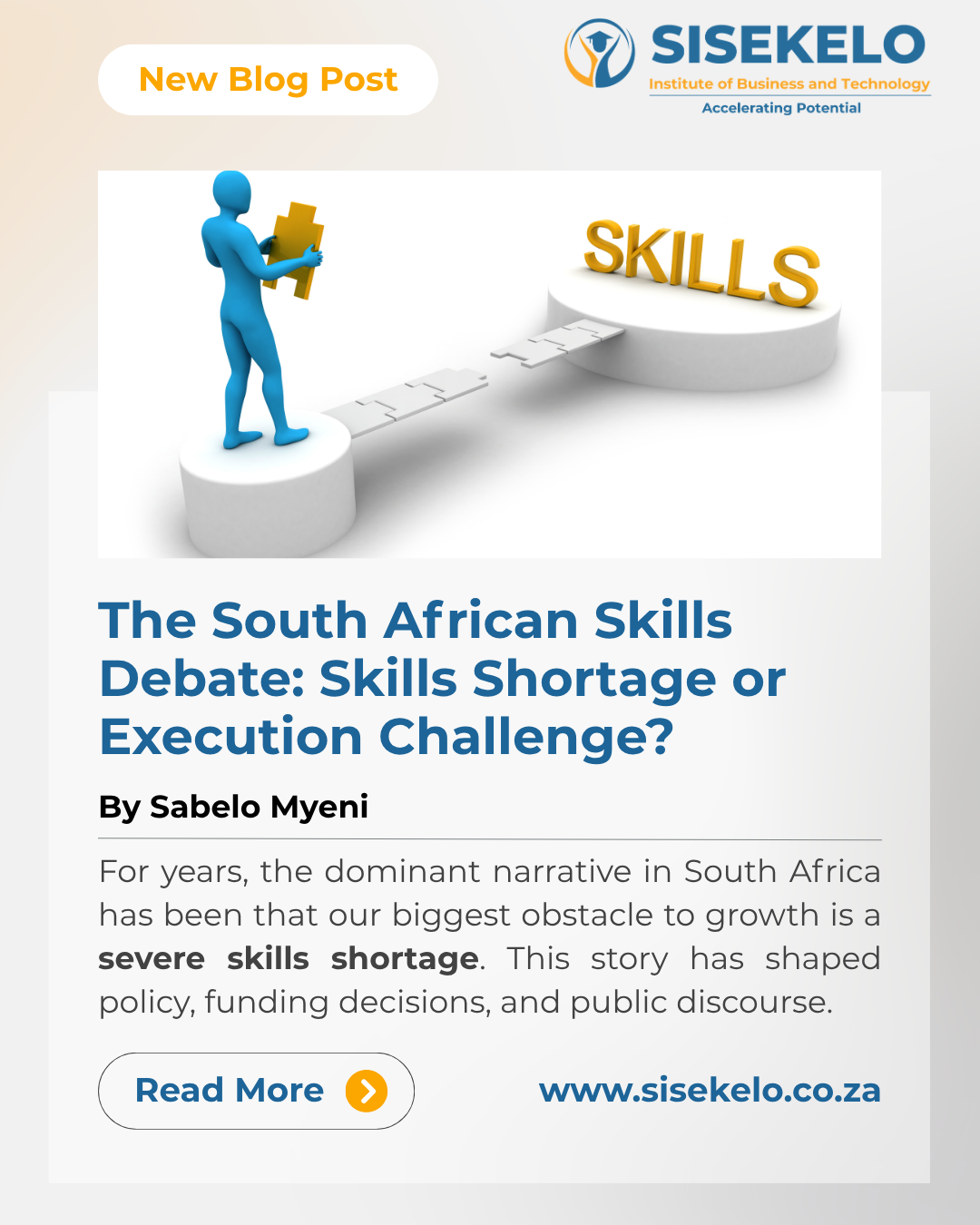
For years, the dominant narrative in South Africa has been that our biggest obstacle to growth is a severe skills shortage. This story has shaped policy, funding decisions, and public discourse. But after years of working across universities, business schools, professional bodies, and private training providers, I believe this narrative is incomplete.
Our real challenge is not a lack of skills; it’s execution.
South Africa does not suffer from a shortage of policy, institutions, or funding. We have 21 SETAs, TVET colleges, universities, professional bodies, learnerships, bursaries, and national development plans. Yet youth unemployment remains painfully high – sitting at 45.8% for those aged 15–34 in Q1 2026. Something is clearly not working.
The uncomfortable truth is this: we are skilling at scale, but too many trained individuals are still considered “unemployable” by employers. This points to a deeper problem; a fragmented and poorly coordinated skills ecosystem that lacks alignment with actual labour market needs.
The System is Well-Funded but Underperforming
The current debate around SETAs has become dangerously polarised: one side wants to dismantle them, while the other defends the status quo. The more accurate view is that South Africa has a well-funded but unevenly performing skills development system.
It has delivered real value through learnerships, workplace-based learning, and sector research. However, it has often become overly bureaucratic, compliance-driven, and disconnected from what businesses actually need. Employers complain about slow processes and training that doesn’t translate into workplace readiness. Training providers struggle to secure meaningful work placements. Meanwhile, young people continue searching for opportunities.
We have been measuring the wrong things; numbers of learners registered, certificates issued, and funds disbursed – instead of asking the harder questions: How many people are becoming truly employable, productive, and economically active?
Reasons for Hope: Reform is Coming
There are encouraging signs of change. The recent relaunch of the Reconceptualised Human Resource Development Strategy (2025–2035) and the Master Skills Plan (2025–2030), along with talk of a “skills revolution,” suggest the government is beginning to shift focus from access to training toward coordination, employability, and economic relevance.
The phrase “One Country, One Plan” embedded in the Master Skills Plan is particularly important. It signals recognition that our skills ecosystem has operated in silos for too long – government, business, academia, and industry all working in isolation.
Five Critical Shifts We Must Make
The future of skills development in South Africa will depend on five bold shifts:
- Move from a training-output mindset to an employment-and-productivity mindset. The goal must shift from simply training people to enabling real economic participation.
- Make workplace-based learning central, not secondary. Real skills are developed where work actually happens – in real workplaces.
- Give employers a much more active role in shaping qualifications, curriculum, and workplace competencies from the beginning, not just complaining at the end.
- Align skills development with future economic priorities – digital economy, artificial intelligence, green industries, infrastructure, entrepreneurship, and industrial innovation.
- Shift to outcome-based accountability. A registered learner is not an empowered learner. A certificate is not a career. A funded programme is not an economic transformation.
A Call to Collective Responsibility
This challenge cannot be solved by the government or SETAs alone. Business leaders must stop treating skills development as a mere B-BBEE compliance exercise and start viewing it as a strategic investment in competitiveness. Professional bodies need to play a stronger role in building adaptable, ethical, and future-ready professionals. Training providers must focus relentlessly on workplace relevance and absorption rates.
South Africa does not lack talent. What we need is the courage and coordination to unlock it.
We don’t need another decade of fragmented implementation. We need urgency, coordination, and measurable impact.
The question is no longer whether we have talent. The real question is whether our systems are agile enough to set that talent free.